Cheap vs. Steep: What We Actually Found When We Tested Budget and Designer Pieces Side by Side
There's a version of this article that tells you expensive is always better and you should save up for "investment pieces." There's another version that tells you designer labels are a scam and fast fashion is just as good. Neither of those versions is honest, and honestly, neither is all that useful.
The truth is messier and more interesting. We spent time comparing similar items across a wide range of price points—talking to people who work in garment production, examining fabric composition labels, and wearing pieces in real life—and what we found is that quality and price have a relationship, but it's not the one most people assume.
Here's what actually matters.
The White Button-Down Test
Few pieces are as telling as a white button-down shirt. It's a wardrobe staple with nowhere to hide—no busy print, no heavy structure, just fabric and construction doing all the work.
We looked at three versions: a $48 option from a mainstream retailer, a $165 option from a contemporary brand, and a $490 option from a heritage label.
The $48 shirt had a polyester-cotton blend (60/40), which felt fine on first wear but showed some pilling after a handful of washes. The buttons were lightweight plastic and one started to loosen by wash number five. The collar lost its shape fairly quickly without starch or ironing.
The $165 shirt was 100% cotton with a noticeably tighter weave—it felt more substantial in hand and held its shape better through washing. Buttons were slightly heavier and better-anchored. The collar stayed crisp longer.
The $490 shirt used a long-staple cotton (think Egyptian or Pima), which is softer and more durable than standard cotton. The stitching was significantly finer—more stitches per inch means less stress on seams over time. The collar had internal boning that kept it structured wash after wash.
The honest verdict: The jump from $48 to $165 delivered real, noticeable improvements in longevity and feel. The jump from $165 to $490 delivered refinements—not transformations. If you're buying a white shirt to wear weekly, the mid-range option is genuinely the sweet spot.
What Quality Actually Looks Like (And How to Spot It)
Before we get into more comparisons, here's a quick field guide to quality markers you can check in person or from product photos and descriptions online:
Fabric composition: Natural fibers (cotton, wool, linen, silk) generally breathe better, last longer, and age more gracefully than synthetic blends. That said, some synthetics—like high-quality nylon in outerwear or technical fabrics in activewear—are genuinely the better choice for those specific applications. Context matters.
Stitching density: Tighter, more even stitching is a sign of better construction. Look at the seams, especially at stress points like underarms and pockets. Loose or uneven stitching is one of the first things to go.
Lining and finishing: Unlined interiors aren't automatically bad, but fraying raw edges inside a garment suggest corners were cut. Finished seams (serged or flat-felled) are a good sign.
Hardware: Zippers, buttons, snaps—these small details tell a big story. Metal hardware tends to outlast plastic. YKK zippers (look for the logo on the pull) are an industry standard for reliability and show up in everything from budget-friendly options to luxury outerwear.
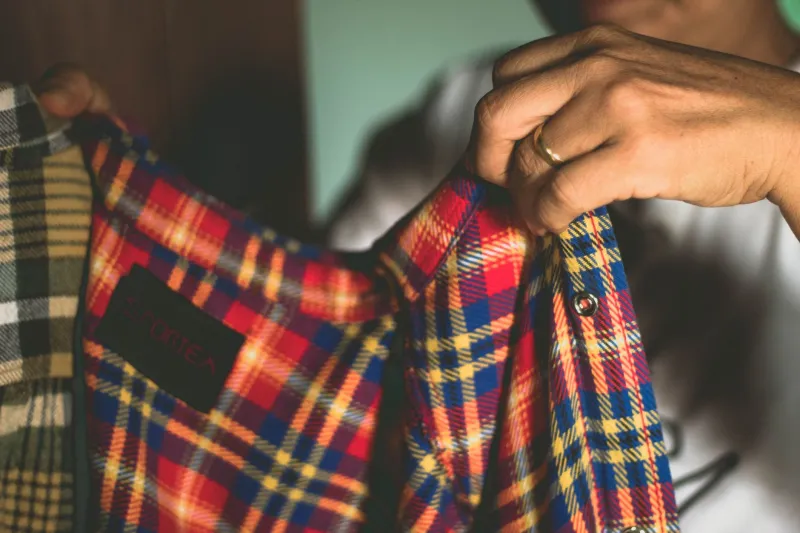
Pattern matching: On plaid, stripes, or prints, check whether the pattern aligns at the seams. Matching patterns at seams requires more fabric and more careful cutting—it's a mark of intentional construction.
The Denim Comparison
Denim is where the price-quality equation gets particularly interesting, because there's a massive middle ground between $30 drugstore jeans and $300 selvedge denim.
We compared a $38 pair from a fast fashion brand, a $98 pair from a mid-tier American brand, and a $275 raw selvedge pair from a heritage denim label.
The $38 jeans used a stretchy poly-cotton blend that felt comfortable immediately but showed distortion at the knees and seat after a few months of regular wear. The dye faded unevenly.
The $98 pair used a heavier, mostly-cotton denim with minimal stretch. They required a brief break-in period but held their shape significantly better over time. The fade pattern that developed was actually flattering—even and gradual.
The $275 raw selvedge pair were a different product category entirely. Stiff at first, they require weeks of wear to truly break in, but the payoff is a jean that molds to your body specifically and develops a patina unique to you. These are genuinely built to last decades with proper care.
The honest verdict: If you wear jeans daily and want something that holds up without babying, the $98 range is a genuinely good investment. The $275 selvedge option is for denim enthusiasts who enjoy the process and the longevity. The $38 pair is fine for occasional wear or a trend you're not sure about yet.
When You're Paying for Branding (And That's Okay to Know)
Let's talk about the elephant in the dressing room: logo-heavy luxury pieces. A $900 belt with a recognizable buckle is not a $900 belt because the leather is nine times better than a $100 belt. You're buying a signal, a status marker, a piece of cultural currency. That's a legitimate reason to buy something—just be clear-eyed that it's what you're doing.
Some people find real value in that signal. Others don't. Neither position is wrong. But confusing branding value with construction value leads to a lot of buyer's remorse.
A useful gut check: if you removed the logo entirely, would you still love the piece? If yes, it's probably worth it to you. If the logo is the whole point, just own that.
The Framework We Use Now
After all of this, here's the simple framework we landed on for making smarter purchasing decisions:
- Spend more on: Basics you wear constantly (denim, white shirts, outerwear, leather goods), items with complex construction (tailored pieces, structured bags), and anything where fabric quality directly affects comfort (knitwear, underwear, bedding-adjacent loungewear).
- Save on: Trend-driven pieces with a short shelf life, items you need in multiples, anything you're not sure about yet, and categories where synthetic materials are genuinely superior (some athletic wear, rain gear).
- Always check: Fiber content, seam finishing, hardware quality, and—where possible—country of production and brand transparency about their supply chain.
Price is a data point, not a verdict. A $60 piece with great construction and a fiber you love will serve you better than a $300 piece you bought because the number felt impressive. The goal is knowing the difference—and now you do.