One Body, Seven Sizes: The Brand-by-Brand Sizing Breakdown You've Been Waiting For
Here's a scenario that probably sounds familiar: you order the same size you always wear, in three different brands, and exactly one of them fits. The other two — one too snug across the shoulders, one swimming at the waist — go straight into the return pile. You haven't changed. The number on the label hasn't changed. So what gives?
Sizing inconsistency in fashion is one of those open secrets the industry has never really bothered to fix. There's no federal standard for clothing measurements in the US. Every brand essentially makes up its own system, which means a "medium" is a suggestion, not a guarantee. We got tired of guessing, so we did the homework — pulling measurements from size charts and product listings across seven popular retailers to map out exactly where the numbers diverge.
Here's what we found, and more importantly, here's how to use it.
Why Sizing Is All Over the Map
The short answer: vanity sizing, target demographics, and manufacturing origin all play a role. Vanity sizing — the practice of labeling a larger garment with a smaller number to make shoppers feel good — has been quietly inflating since the 1980s. A size 8 today is roughly equivalent to what a size 14 or 16 was in 1958, according to research published by the American Society for Testing and Materials.
Beyond that, brands design for a specific "fit model" — a person whose measurements they use as the baseline for their entire size range. If a brand's fit model runs narrower through the hips than average, every piece they make will reflect that. You're not the problem. Their baseline is just different from your body.
Then there's manufacturing origin. Brands that produce primarily in Asian markets often size down compared to brands manufacturing in the US or Europe, simply because their legacy size charts were built around different average measurements.
The Seven-Brand Breakdown
We looked at women's sizing specifically (though the same logic applies across all categories), focusing on the bust, waist, and hip measurements listed for a size Medium at each retailer.
Madewell runs true to size for most people, with a medium landing around 35–37" bust, 27–29" waist, and 38–40" hip. Their denim especially is worth sizing up one if you're between sizes — the stretch is minimal in their rigid styles.
Zara skews notably smaller. Their medium tracks closer to 34–36" bust and 26–28" waist. If you're used to shopping American brands, go up at least one size, sometimes two. Their European-origin sizing hasn't shifted toward US norms the way some competitors have.
Free People runs generously — think relaxed, bohemian-leaning fits where a medium can accommodate up to a 38" bust comfortably. Their size charts are more forgiving, and their stretchy knit pieces especially have a wide range of wearability.
H&M is famously inconsistent even within its own brand, varying by line and country of manufacture. Their Divided line tends to run smaller; their basics and lounge lines run truer. The safest move with H&M is always to check the specific garment's measurements, not just the size label.
Anthropologie sits in a middle-ground zone that's reasonably consistent across their private label pieces — medium typically means 35–37" bust — but their wide range of vendor partners means a medium in one brand carried on their site might differ significantly from another.
ASOS is a mixed bag by design, since they carry hundreds of brands alongside their own label. ASOS Design (their house brand) runs fairly true to UK sizing, which means US shoppers should size up one. Their size guide does include centimeter measurements, which is genuinely the most useful tool on their site.
Target (A New Day, Universal Thread) has made a real effort toward size inclusivity and their charts are among the more transparent in the mass market. Their medium aligns with approximately 36–38" bust. Fit tends to be relaxed and accommodating, which makes them a reliable baseline for many shoppers.
Your Personal Sizing Decoder
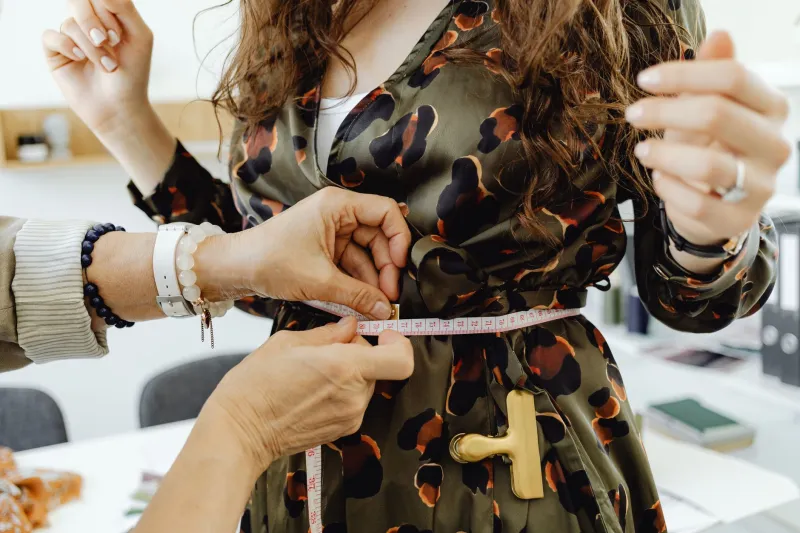
The single most useful thing you can do before buying anything online is take your own measurements. Not your "size" — your actual inches. You need four numbers: full bust, natural waist (the narrowest point, usually an inch or two above your belly button), full hip (the widest point), and inseam for bottoms.
Write them down. Screenshot them. Tattoo them somewhere convenient. These numbers are your north star.
Once you have them, here's the framework:
Step 1: Ignore the size label on the product page. Seriously. It's almost decorative at this point.
Step 2: Find the brand's size chart and locate the actual measurement ranges. Most retailers bury this, but it's usually under a "Size Guide" link near the product details.
Step 3: Match your measurements to their chart, not to what size you "are." If your measurements put you between sizes, consider the garment's construction — structured blazers and fitted dresses leave less room for error, so go up. Flowy blouses and stretch fabrics offer more flexibility.
Step 4: Read the reviews and filter by body type. Shoppers who mention their height, weight, or measurements in reviews are doing you a real favor. Look for people whose proportions sound similar to yours and pay attention to how they sized.
Step 5: Check the return policy before you click buy. Even with perfect measurement-matching, fit is sometimes just a matter of how a garment falls on your specific frame. Shops with free returns — Nordstrom, Zappos, many direct-to-consumer brands — give you the freedom to order two sizes and send back the one that doesn't work.
The Brands Worth Bookmarking for Consistency
If you're building a wardrobe and want to minimize the guessing game, a few brands have earned a reputation for reliable, consistent sizing over time. Everlane publishes detailed fit notes on each product page, including model height and the size they're wearing. Universal Standard (a size-inclusive brand running 00–40) uses the same fit model across their entire range to ensure consistency. And Quince, which has grown a loyal following for its accessible luxury basics, tends to run true to size with clear measurement charts.
The Bottom Line
You are not a different size every time you walk into a store. The stores just haven't agreed on what size means. Until the industry gets its act together — and honestly, don't hold your breath — your best protection is knowing your measurements, reading the fine print on size charts, and treating every online purchase from a new brand as a small experiment.
The good news? Once you've cracked a brand's code, you've got it forever. Keep a running note on your phone with your go-to size at each retailer you shop regularly. It takes the mystery out of online shopping and turns a frustrating process into something that actually works in your favor.