Stop Piling On: The Real Rules of Layering That Actually Work

Let's be honest: most of us learned to layer by accident. A cold morning, a sweater grabbed off the chair, done. And while that works in a pinch, it's not exactly what the stylists mean when they talk about layering as an art form. The truth is, there's a whole language to building outfits in layers — and once you learn it, you'll wonder how you ever got dressed without it.
Layering isn't about bulk. It's about dimension, proportion, and knowing which fabrics want to live next to each other. Get those things right, and suddenly a wardrobe of 20 pieces feels like 60.
The Myth That's Been Tripping You Up
Here's the big one: most people think layering is purely a cold-weather move. T-shirt, long sleeve, sweater, coat — stack and go. But that approach treats layering like a warmth equation rather than a styling strategy, and it almost always ends up looking boxy or unintentional.
Real layering works in every season. A linen shirt left unbuttoned over a fitted tank? That's a spring layer. A lightweight slip dress worn over a ribbed turtleneck? That's a fall layer that actually looks cool. The goal isn't always warmth — sometimes it's texture, color contrast, or simply making an outfit more visually interesting.
Fabric Pairings That Work (And Some That Really Don't)
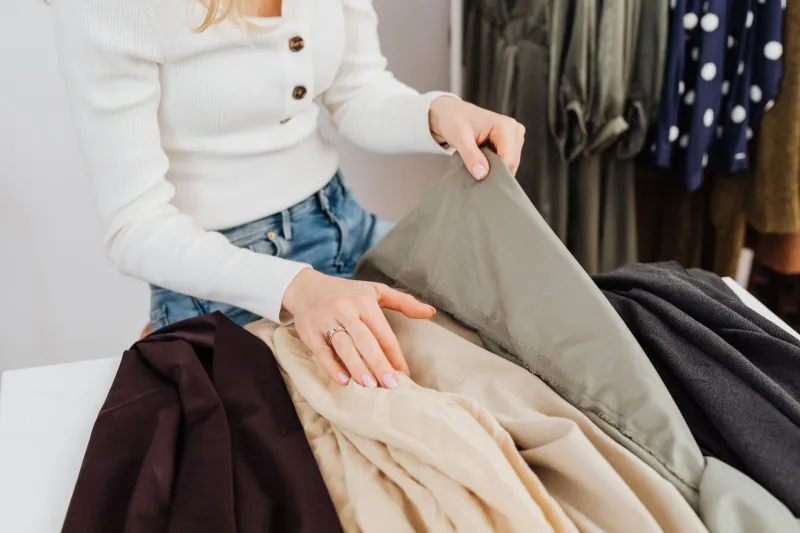
This is where most people go wrong, and it's also where the magic happens. Fabrics have personalities, and some get along better than others.
Winners:
- Denim over silk or satin — The contrast between structured and fluid is a classic for a reason. An open denim jacket over a silky cami is effortlessly put-together.
- Knit over chiffon — A chunky knit cardigan layered over a flowy chiffon blouse creates that cozy-meets-feminine moment that's been all over Pinterest for good reason.
- Cotton under leather — A crisp white tee under a leather jacket is basically a uniform at this point. It works because the textures are complementary without competing.
- Linen with linen — Tonal layering within the same fabric family, especially in summer, reads as very intentional and elevated.
Combinations to avoid:
- Chunky knit over a chunky knit — Too much visual weight, and you'll feel like you're wearing a blanket burrito.
- Slippery fabrics stacked together — Satin on silk on chiffon? Everything slides, bunches, and fights for real estate.
- Heavy wool directly against delicate lace — The friction will damage the lace over time, and it rarely looks great anyway.
Layering for Your Body Type — Not Against It
One of the most common layering complaints is that it adds bulk in all the wrong places. And yes, if you're layering without thinking about proportion, that can absolutely happen. But the fix is simpler than you'd think.
If you're petite: Keep layers close to the body and avoid letting them hang past your hip. A fitted vest over a long-sleeve tee, or a cropped jacket over a tucked blouse, keeps proportions clean. Avoid overwhelming your frame with oversized everything — one loose piece is enough.
If you're tall: You can pull off longer layering combinations that would drown a shorter person. A longline blazer over a midi dress, or a duster cardigan over wide-leg trousers, works beautifully when you have the height to carry it.
If you're curvy: Layering can actually be your best friend when it comes to creating definition. An open-front layer (cardigan, blazer, duster) creates a vertical line that elongates and flatters. Avoid layering multiple fitted pieces on top of each other without a break — that's where things can feel constricting rather than styled.
If you're straight or boyish: You can use layering to create the illusion of curves. Belting a layer at the waist, or choosing pieces that have volume at the hip, adds shape where you want it.
Seasonal Strategy: A Quick Breakdown
Layering looks different depending on the time of year, and adjusting your approach seasonally is what separates someone who looks styled from someone who just looks cold.
Fall/Winter: This is your heavy-lifting season. Think base layer (fitted turtleneck or thermal), mid layer (sweater or vest), and outer layer (coat or oversized blazer). The trick here is to make sure each layer is visible — even slightly. A pop of turtleneck above a crewneck sweater, a shirt cuff extending past a jacket sleeve. Those little details tell people the layering was on purpose.
Spring: Lighter fabrics, looser silhouettes. An unbuttoned linen shirt over a fitted tank, or a lightweight trench over a sundress with sneakers. Spring layering is more about styling than warmth, so lean into color and texture.
Summer: Yes, you can layer in summer. Think sleeveless vests over breezy blouses, sheer tops over bralettes, or an open button-down as a cover-up over a fitted dress. Airflow is everything — choose fabrics that breathe.
The One-Third Rule (And Why It Changes Everything)
If there's one practical guideline that transforms how layering looks, it's this: each layer should be visible in roughly equal thirds. When one layer completely swallows another, the effect falls flat. When you can see a sliver of each piece — the hem of a shirt peeking below a sweater, the collar of a button-down above a vest — the outfit reads as considered and complete.
This is also why fit matters so much when layering. Pieces that are too oversized or too long make it hard to achieve that balance. Tailored or fitted base layers give you a clean foundation to build on.
Layering as a Wardrobe Multiplier
Here's the part we love most: when you get good at layering, you need less. A white button-down, a fitted turtleneck, a denim jacket, a slip dress, a cardigan — these five pieces alone can generate dozens of distinct looks depending on how you combine and layer them. That's the real value of learning this skill.
At The Wootique, we're big believers in buying less but wearing more. Layering is one of the most effective ways to do exactly that — and once it clicks, you'll start looking at everything in your closet differently.
Start small. Pick two pieces you've never thought to wear together and see what happens. The worst outcome is that you learn something. The best outcome is a new favorite outfit you never would have found otherwise.