You Already Own It: How to Unearth the Outfits Hiding in Plain Sight

Let's be honest: most of us have a closet that's somewhere between "I have nothing to wear" and "I literally cannot close this door." The wild thing? Both of those feelings can exist at the same time, in the same wardrobe. If that sounds familiar, you're not alone — and you're also not out of options.
The solution isn't always a shopping haul. Sometimes it's a Saturday afternoon, good lighting, and a willingness to actually look at what you've got. Think of it as a treasure hunt, except the treasure is that silk blouse you bought two years ago and shoved behind your winter coats.
This isn't about ruthlessly purging your closet (we've got other guides for that). This is about discovery — seeing your existing wardrobe through a fresh set of eyes and unlocking combinations you didn't know were possible.
Start With the "Exile Zone"
Every closet has one. It's the back section, the bottom drawer, the shelf you need a step stool to reach. This is where pieces go when you're "not sure" about them — not ready to donate, but not quite in rotation either.
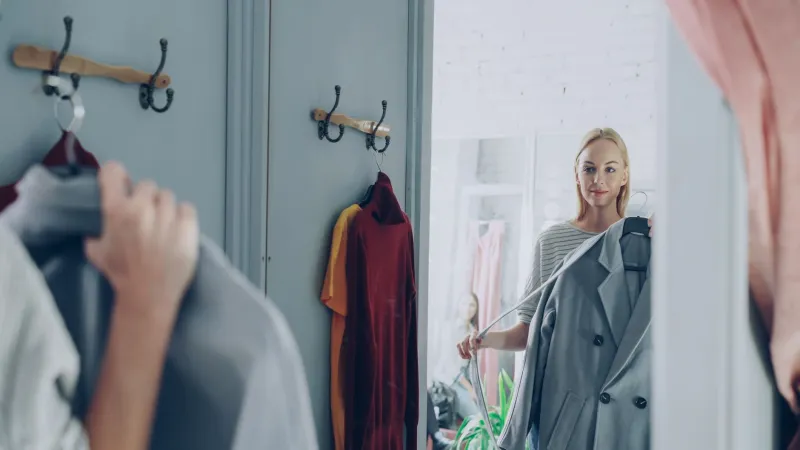
Pull everything out of that zone and lay it flat on your bed. Don't judge yet. Just look. You're going to be surprised by what's in there. A pair of wide-leg trousers that felt too fashion-forward two years ago? Very now. A chunky knit cardigan you thought was too casual? Cardigans are practically the unofficial uniform of effortless cool at this point.
Give each piece a fair look without the context of where it's been hiding. First impressions reset when you remove the "exile" label.
Photograph Everything (Seriously, Everything)
This step sounds tedious, but it's genuinely a game-changer. Grab your phone and take a flat-lay or hanger shot of every single piece you own. Tops, bottoms, dresses, jackets, shoes — all of it.
Why? Because your brain processes a grid of photos differently than it processes a packed closet rod. When you can scroll through your wardrobe like a shopping app, you start making connections you'd never see otherwise. That olive utility jacket suddenly looks amazing next to the rust-colored midi skirt you've been wearing with exactly one outfit for three years.
You can use a notes app, a simple photo album folder, or even a free app like Stylebook or Whering if you want to get fancy about it. The format matters less than the habit of actually seeing your clothes as individual pieces rather than one big overwhelming mass.
The "Stranger" Test
Here's a fun exercise: go through your closet and pull out any piece that feels like it belongs to a stranger. Maybe it was an impulse buy that never quite clicked, a gift you felt obligated to keep, or something you wore once to a specific event and never touched again.
Instead of immediately donating these, try them on with fresh eyes — and different pieces than you originally paired them with. A flowy floral skirt that felt "too dressy" might be exactly right with a vintage band tee and sneakers. A structured blazer that read "corporate" might hit completely differently over a slip dress and mules.
Context is everything in fashion. Sometimes a piece isn't wrong — it's just been hanging out with the wrong neighbors.
Build a Combination Map
Once you've photographed your pieces and done the stranger test, it's time to actually map out combinations. This doesn't have to be complicated. Take a piece of paper (or a notes doc) and pick five items you wear constantly. These are your anchors.
Now, for each anchor piece, challenge yourself to list five things it could pair with that you've never tried before. Your go-to dark wash jeans? Pair them with that silky button-down you've only worn tucked into skirts. Your trusty white tee? Try it under a slip dress instead of alone.
The goal is to break your own pattern. Most of us default to the same 10-12 outfit combinations out of habit, not necessity. A combination map forces you to think differently — and usually reveals that you have way more outfit options than you realized.
Accessories Are the Real Buried Treasure
If you want to completely transform a piece without buying anything new, accessories are your secret weapon — and they're almost always the most neglected part of the closet audit.
Dig out every scarf, belt, hat, bag, and piece of jewelry you own. Lay it all out together. You might find a silk scarf that works as a top, a vintage brooch that could update a blazer lapel, or a belt that completely redefines the shape of a dress you've been wearing wrong.
A simple white button-down goes from basic to intentional with the right belt cinched at the waist. A plain black dress becomes a whole different outfit with a statement necklace and a structured tote instead of a crossbody. Accessories are the lowest-effort, highest-impact way to remix what you already own.
Set a "New Outfit" Challenge for Yourself
Here's where it gets fun. After your audit, commit to wearing one outfit combination per week that you've never worn before — pulled entirely from your existing wardrobe. No new purchases allowed.
Document it. Take a mirror selfie, save it to your photo album, or share it somewhere if that's your thing. The act of documenting makes you more intentional about what you're putting together and gives you a reference point for future outfits.
By the end of a month, you'll have four new combinations in your rotation — and a much clearer sense of what your wardrobe is actually missing versus what it's simply been hiding from you.
When You Actually Do Need Something New
After a thorough audit, you'll have a much sharper picture of genuine gaps. Maybe you have tons of tops but almost no bottoms that feel current. Maybe your outerwear situation is dire. Maybe you realize you've been avoiding color entirely and want to ease in with one great statement piece.
That clarity is valuable. Instead of shopping out of habit or boredom, you're shopping with intention — which means you'll actually wear what you buy. And when you do add something new, you already know exactly what it needs to work with.
Your closet is more full of possibility than you think. Sometimes the best thing you can do for your style isn't adding more — it's finally paying attention to what's already there.